07/01/2026 Jewelry, General
As summer reaches its height in New York City, tree-lined streets and neighborhood gardens burst into bloom, their canopies painted in every shade of green and punctuated by flashes of brilliant color. It is a season that reminds us how nature can inspire beauty, making it the perfect moment to revisit some of the remarkable Cartier Tutti Frutti jewels that have passed through DOYLE. Alive with carved emerald leaves, ruby blossoms, and sapphire berries, these extraordinary creations are among the most colorful expressions of twentieth-century jewelry design.
Yet beneath their joyful abundance lies a fascinating story of artistic exchange. Rather than simply drawing inspiration from nature, Cartier's earliest Tutti Frutti jewels grew from a meeting of two extraordinary traditions: the centuries-old gemstone carving of Mughal India and the sleek elegance of Parisian Art Deco. Together, they gave rise to a style unlike anything the jewelry world had seen before.
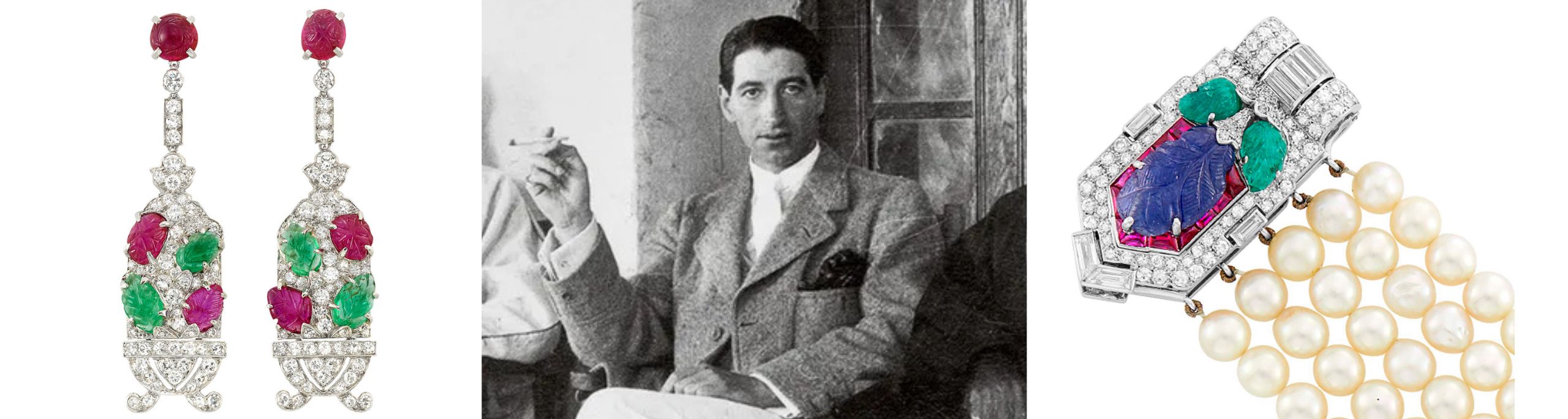
The story begins with Jacques Cartier (1884-1941), son of the company's founder Louis Cartier, whose travels throughout India in 1911 profoundly shaped the future of the maison. Journeying through bustling bazaars and princely treasuries, he encountered carved emeralds, rubies, and sapphires unlike those commonly seen in Europe. Mughal jewelers had historically favored richly colored gemstones carved with delicate floral and foliate motifs, celebrating the natural world through vines, blossoms, and leaves. Jacques returned to Europe with Indian jewelry and carved gemstones that would profoundly influence Cartier’s designs. The maison exhibited some pieces in their original form, while others were altered or incorporated into new settings shaped by contemporary Parisian taste.
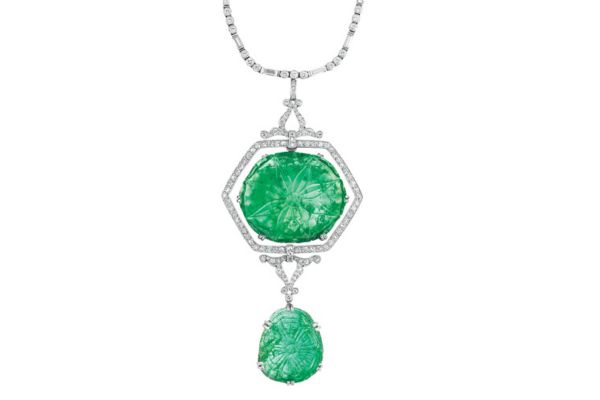
That dialogue is beautifully illustrated by a Platinum, Diamond and Carved Emerald Pendant, where two vivid carved emeralds appear to float within a platinum and diamond setting. The emeralds, each featuring a softly carved flower, speaks directly to Mughal traditions, where emeralds were treasured both for their beauty and their symbolic association with paradise. Surrounding it, a delicate yet flexible latticework of platinum and diamonds creates an elegant sense of lightness, allowing the vibrant green stone to appear almost suspended in midair. The result is a quiet harmony between the two stylistic traditions, combining to create vibrancy previously unknown to the maison and the wider European public.
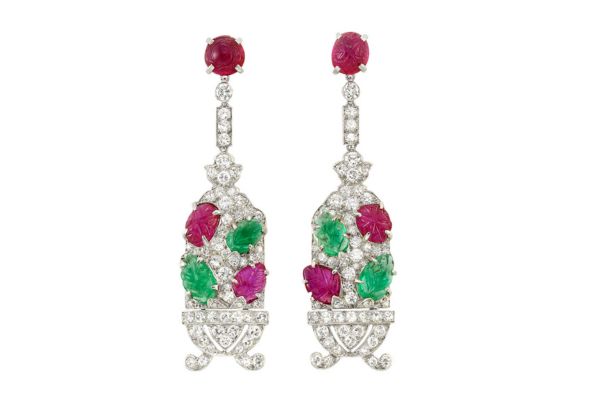
By the mid-1920s, Cartier had transformed these early experiments into the exuberant Tutti Frutti style. A pair of Art Deco Platinum, Diamond and Carved Emerald and Ruby Pendant Earclips captures this evolution in full bloom. While the carved emeralds and rubies preserve the floral traditions of Mughal gemstone carving, their influence no longer ends with the stones themselves. Leaves and blossoms seem to spill beyond their carved surfaces, shaping the jewel's entire composition into what resembles a flowering plant rising gracefully from its basket. Yet this celebration of nature is carefully orchestrated through the refined vocabulary of Parisian Art Deco. Delicate platinum mountings, diamond-set frameworks, and precise symmetry lend structure to the organic forms, demonstrating how Cartier transformed Indian motifs into an entirely new design language.
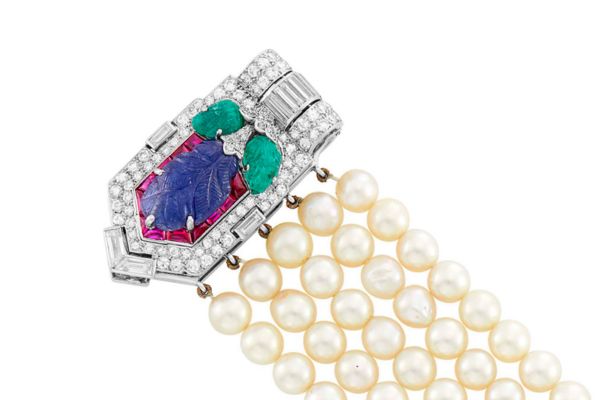
A Platinum, Carved Colored Stone and Diamond Tutti Frutti Clip-Clasp with Cultured Pearl Torsade Bracelet brings together an especially rich palette of materials. Alongside Cartier's clip-clasp set with carved emeralds, rubies, and sapphires is a flowing strands of pearls, a material long prized in both Indian and European jewelry traditions. Together, these gemstones recall the Indian concept of the Maharatnani, or "five great gemstones," lending the bracelet an added layer of cultural significance. Rather than treating each material as an isolated decorative element, Cartier orchestrates them into a unified composition, where the vibrant clasp gives way to softly twisting pearl strands, creating a sense of rhythm and movement that carries the eye across the jewel.
More than a century after Jacques Cartier's first journey to India, Tutti Frutti jewels continue to captivate collectors not simply for their extraordinary craftsmanship, but for the story they tell. Like a garden in full bloom, they celebrate color, movement, and the beauty of the natural world. More importantly, they stand as lasting reminders that some of the most remarkable works of art are born when cultures meet, traditions intertwine, and inspiration is allowed to flourish.
— Mimi Fowlkes
DOYLE New York
Summer Intern 2026
Consignments are currently being accepted for the Fall Auction Season. Discover the value of your collection!
Information & Appointments: 212-427-4141, ext 221 or Jewelry@Doyle.com