02/05/2026 General, General Paintings
NEW YORK, NY -- Henry Stull (1851–1913) is widely recognized as one of the leading 19th century painters of American thoroughbred racehorses. Born in Hamilton, Ontario, Stull was exposed early to horses through his father, who worked as the driver of a horse-drawn hack. In 1873, Stull moved to New York City with ambitions of becoming an actor, but after failing in the theater he turned to illustration to earn a living.
Stull’s artistic career began at Leslie’s Weekly, where he produced caricatures and cartoons. His interest in racehorses soon dominated his work, leading to published illustrations in Sporting New Yorker, Spirit of the Times, and Harper’s Weekly, where his racehorse portraits debuted in 1883. To enhance realism, he studied equine anatomy at a veterinary college, achieving a level of muscular accuracy that distinguished his paintings.
His refined portraits attracted prominent patrons, including William Collins Whitney, August Belmont, Pierre Lorillard and other titans of the Gilded Age. Stull died in 1913, the same year the Brighton Beach racetrack closed, marking the end of an era in American racing.
Featured in A Vanderbilt & Whitney Legacy Part II: The Collection of Marylou Whitney & John Hendrickson are eight equestrian paintings by Henry Stull that underscore his enduring role as a visual chronicler of the early years of American horse racing and his lasting influence on sporting art. The works have descended through three generations of the Whitney family beginning with William Collins Whitney (1841-1904), grandfather of Cornelius Vanderbilt Whitney and the founder of the Whitney racing dynasty.

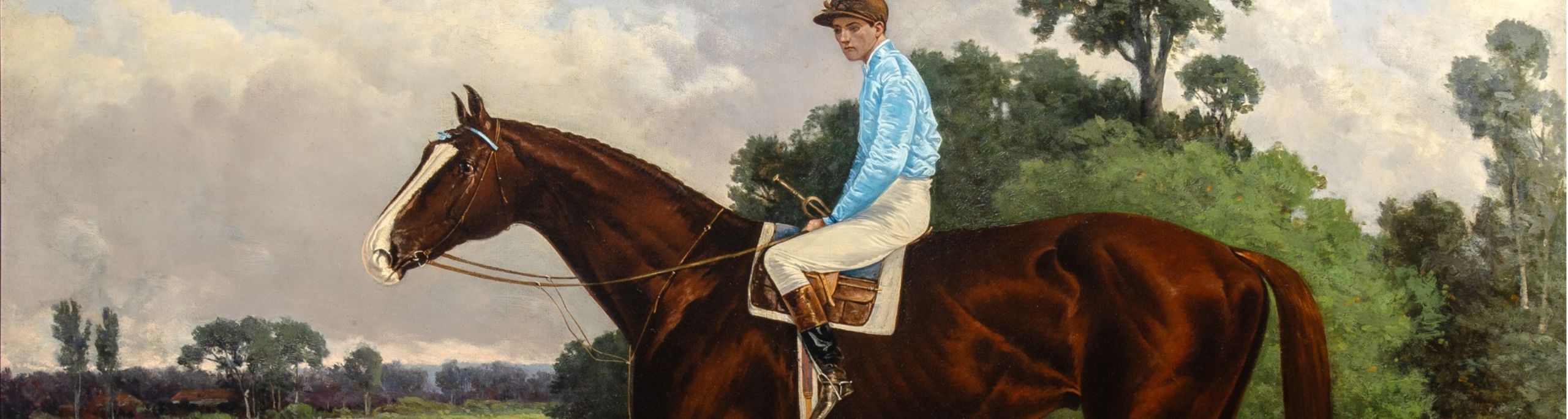
Purchased by William Collins Whitney in 1901 for a then-record $50,000, Nasturtium (1899–1916) was celebrated as the American Champion Two-Year-Old Colt of 1901, the year this work was painted. He won three of his five starts, highlighted by a track-record victory in the Flatbush Stakes at Sheepshead Bay. Whitney set his sights on England’s 1902 Epsom Derby, sending Nasturtium abroad aboard a specially outfitted steamer, but the colt was unable to compete after falling ill shortly following his arrival. The jockey is shown wearing the famous Whitney colors -- "Eton blue" silks paired with a brown cap. William Collins Whitney purchased these colors from the Earl of Durham, who found himself in financial straits and was happy to rid himself of what he called unlucky colors. Over three generations, the Whitneys produced more stakes winners than any other family in U.S. racing history, with Eton blue and brown becoming emblematic of victory on the turf. View Lot 8

Meddler (1890–1916) was an undefeated British Thoroughbred who became one of the most influential stallions in American racing history after being acquired by William Collins Whitney for $49,000 in 1898. He led the American general sire list twice, in 1904 and 1906, establishing his reputation as a leading sire of champions. View Lot 9

William Collins Whitney purchased Shillalah (1898–1904) in late 1901, considered one of the finest jumpers of the period. Under Whitney’s ownership, Shillalah dominated the sport, winning the Grand National Steeplechase at Sheepshead Bay in both 1902 and 1903, the nation's most prestigious jump event at the time. View Lot 10. Also offered is a Tiffany & Co. commemorative silver-mounted hoof inkwell. View Lot 73

Daughter of William Collins Whitney’s Hall of Fame stallion Hamburg, Hamburg Belle (1901–1913) was a champion Thoroughbred filly whose most significant triumph came in the 1903 Futurity Stakes at Sheepshead Bay. Organized by the Coney Island Jockey Club, the Futurity Stakes was at that time the nation’s richest and most prestigious race for two-year-olds. Owned by James Ben Ali Haggin, who had been outbid by Whitney in 1901 for Hamburg, Hamburg Belle raced under the orange silks of English aristocrat Sydney Paget, a relative of Whitney’s by marriage who managed Thoroughbred racing operations for Whitney, Haggin and other prominent owners. View Lot 11

William Collins Whitney's acquisition of Sir Vassar in 1897 marked a pivotal moment in his transition from a casual observer to a prominent figure in American Thoroughbred racing. Sir Vassar famously won the Amateur Cup at the Country Club of Westchester in 1898, the year this work was painted. Throughout 1898 and 1899, the horse was a regular fixture at major venues in New York. View Lot 12

Blue Girl (1899–1919) was a champion filly purchased by Whitney in 1901, the year this work was painted. She was recognized as the National Champion 2-year-old female in 1901 and 3-year-old female in 1902, before becoming a foundational mare for Whitney’s stables. View Lot 13

Named for the French artist, Jean Beraud was purchased by William Collins Whitney in 1898, the year this work was painted. Jean Beraud saw his greatest triumph the following year in 1899, winning the Belmont Stakes at Morris Park Racecourse and setting a new track record. Jean Beraud was listed at the Belmont Stakes under Sydney Paget, a relative of Whitney’s by marriage who managed Thoroughbred racing operations for Whitney and other prominent owners. View Lot 14

This portrait of Admiration was painted in 1899. View Lot 15
Auction Wednesday, February 11, 2026 at 10am
Exhibition February 5 - 9