08/06/2026 General, Coins, Bank Notes & Postage Stamps
Christopher Nolan’s The Odyssey has many folks thinking about the ancient Mediterranean, and it’s impossible for a numismatist not to think about the coinage of the ancient world with ancient kings, deities, and battles on the big screen. Many of the characters brought to life by some of the 21st century’s best actors in the film appeared on coinage of the ancient Mediterranean over the course of centuries. Though produced centuries after Homer (indeed, coinage itself had not yet developed when the Odyssey was first written and performed), these coins offer tiny windows into the mythic and actual past of the ancient Greek world, pocket-sized reminders of the persistence of their stories.
The August 12 auction of Coins, Medals, Paper Money & Sports Memorabilia offers a selection of ancient Greek coins, several of which depict mythological figures and creatures that feature in the film.
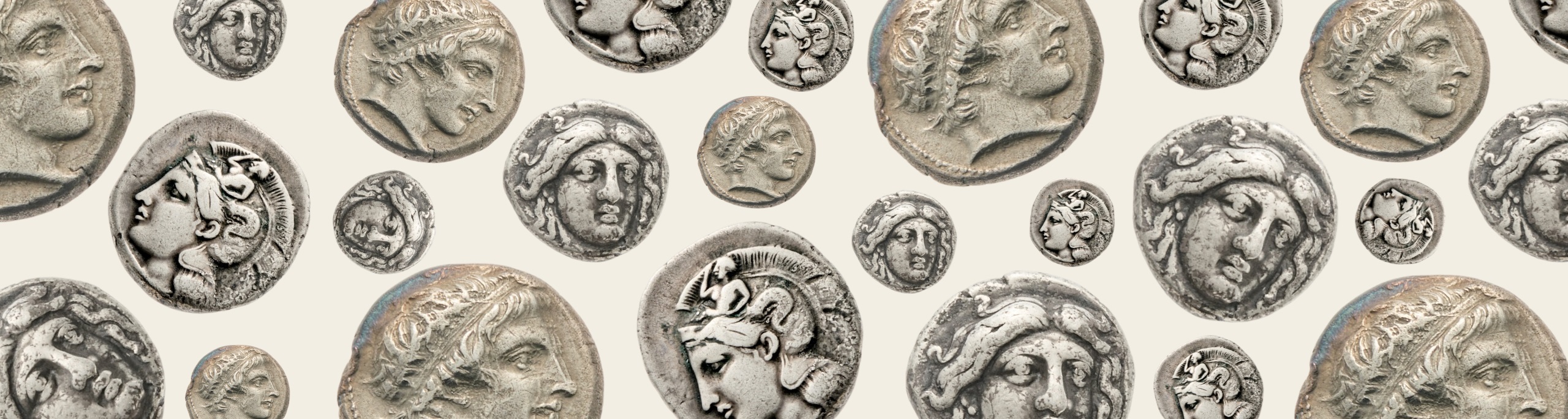
A wise goddess and notable monster appear on a silver didrachm struck in the Greek Italian colony of Thourioi struck in late fifth or early fourth century B.C.E. (Lot 8). Athena, played by Zendaya in Nolan’s film, appears helmeted on the obverse, facing left. Scylla, a sea monster past which Odysseus and his crew must navigate after escaping Hades and passing the Sirens, appears on her helmet. Athena also appears paired with a pegasus reverse motif on a silver stater (Lot 4) struck in Epirus, a region in northwestern Greece.
Partway through Odysseus' journey, his men slaughter the cattle of the sun god Apollo, who appears on the obverse of a tetradrachm of the late fourth century B.C.E. issued under the authority of King Patraus of Paeonia, in present-day North Macedonia (Lot 12). A dynamic scene of a soldier on horseback spearing an enemy appears on the reverse. Apollo also appears on the obverse of Lot 5, a Macedonian silver stater struck around the turn of the fifth and fourth centuries B.C.E.
In Homer’s text, the cattle attributed to Apollo in the film belong to Helios, another sun god.
Helios appears on the obverse of a silver didrachm (Lot 14), struck sometime between 336 B.C.E. and 316 B.C.E. in Caria, the region of present-day Turkey close to the island of Rhodes. A rosebud and a bunch of grapes appear on the didrachm’s reverse; flora and food are common motifs on ancient coinage from a range of civilizations.
Though they don’t depict anything that appears in the Odyssey, the other ancient coins in the sale have charming, often dynamic designs that, like their slightly more cinematic counterparts, offer a glimpse into the lives and values of the ancient people who designed and produced them.
Doyle has, in the recent past, handled coins produced closer to the time of Homer, like an electrum hemiobol struck in Ionia, a region in Asia Minor relatively close to the widely acknowledged real-life location of ancient Troy. Produced in the mid-to-late seventh century B.C.E., the tiny coin (view here) was offered in our June 2025 sale of The Carol F. Ross Collection of Ancient Roman Coins.
Auction Wednesday, August 12, 2026 at 10am

Chris Bulfinch
Appraiser and Specialist of Coins, Stamps, Currency and Collectibles