05/20/2026 General, American Furniture & Decorative Arts
BOSTON, MA—The name Paul Revere calls to mind his legendary midnight ride at the start of the American Revolution, in April 1775. Thanks largely to Henry Wadsworth Longfellow’s famous poem, Revere’s name is among the most recognizable in early American history. Yet, that midnight ride that has become American mythology is just one episode in a diverse life. Both before and after the Revolution, Revere was a skilled artisan and ambitious entrepreneur whose work influenced Boston's material culture and was found in the homes of prominent Bostonians in the late eighteenth and early nineteenth centuries.
Revere was born in 1735 and as early as the age of 13 was apprenticed to his father, also a silversmith, and trained as a silversmith, goldsmith, and engraver. He had surpassed his father’s prominence by the end of the third quarter of the 18th century, having built a thriving workshop that served many of Boston’s prominent citizens. His clients included merchants, clergy, and civic leaders, and he associated with figures like John Hancock and Samuel Adams, fellow patriots and key members of Boston’s political and commercial circles. The silverware produced in his shop—from tankards and teapots to spoons and serving pieces—not only fulfilled practical needs but also symbolized status and refinement in the young republic. Revere’s craftsmanship is evident in pieces that are celebrated as prime examples of early American artistry.
The war put silversmithing on hold, and when he returned to it in the late 1780s, the market had changed. Undeterred, he adapted to the changes – moving from the higher end and customized pieces that defined his early work, to smaller pieces of silver – spoons and other utilitarian goods. Later in the century, he expanded his enterprise to include iron and copper casting for church and school bells, and larger-scale industrial projects such as copper rolling for architectural use and shipbuilding.
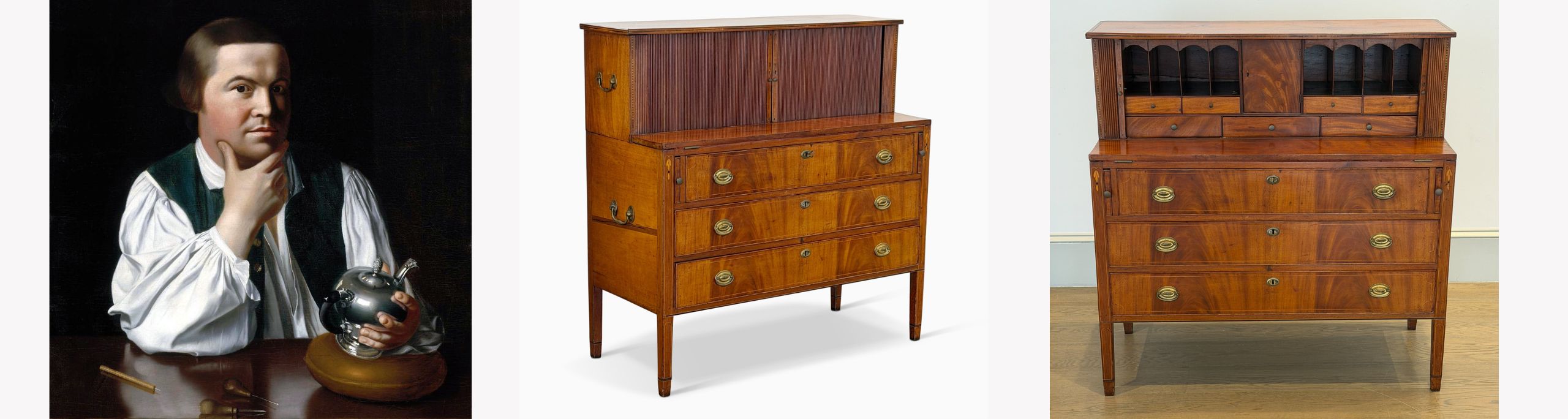
So, it is clear that Revere’s talents extended beyond craftsmanship; he was a businessman who embraced new opportunities in changing markets and took financial and reputational risks during those times of change. This entrepreneurial drive relates closely to Revere’s desk, which has descended through the Revere family in an unbroken chain of ownership. Based on the form and certain elements of its restrained ornamentation, it was likely made in Boston, around 1795. It is supposed, though there is no known documentation, that he acquired it directly from the cabinetmaker. Based on the timing of where he lived and worked, Revere almost certainly used this desk in Boston and brought it to Canton, Massachusetts, to where he expanded his headquarters in 1801.
Desks like this would function as the command center of a business—where records were kept, correspondence was managed, and decisions were made. The pigeonholes and compartments flank a locking door where the most sensitive materials were likely kept – everything has its place. In this way, it serves as an apt symbol of Revere’s world. While his renowned physical creations—printed engravings, silver tablewares, cast metal church bells, and rolled copper—demonstrate his skill and understanding as a craftsman, this desk embodies the mind of the entrepreneur: careful record-keeping, planning, and commercial relationships enabled Paul Revere to build a successful enterprise in the years after the Revolution.
Featuring The Paul Revere Desk and a Paul Revere Silver Ladle.
Boston Auction Friday, June 5, 2026 at 11am
Boston Exhibition May 30 - June 2
Sale Info


Above: The Paul Revere Federal Inlaid Mahogany Tambour Desk, Probably Boston, circa 1795. Property from the Descendents of Paul Revere. Est. $20,000-30,000. Lot 140. / Paul Revere Silver Ladle, Boston, circa 1790. Est: $8,000-12,000. Lot 48.
View Lots