
04/06/2026 General, Coins, Bank Notes & Postage Stamps
With America’s Semiquincentennial in mind, I’ve highlighted a selection of notable, popular coins featured in the upcoming auction of Coins, Bank Notes, Stamps & Collectibles on April 17, 2026. I’ve grouped them under the alliterative theme “Saints, Shipwrecks and Silver Dollars,” and this essay will explore each category in turn.


SAINTS
Augustus Saint-Gaudens is a name likely familiar to many outside of the coin world. Responsible for public monuments from Chicago to Dublin, and numerous sculptural works that reside in some of the world’s foremost museums and art collections, Saint-Gaudens closed his decades long career by designing one of the United States’ most beautiful coins: a $20 gold piece, or “double eagle,” that today is referred to by his name.
At the outset of the twentieth century, President Theodore Roosevelt decided the United States’ coinage failed to adequately represent the ideals and aesthetics of a growing republic. He had a point—by the turn of the century, some circulating designs had been in production for five decades or more, and had grown somewhat staid. Roosevelt tasked Saint-Gaudens with creating designs for U.S. gold coins “as artistic as the Greeks could desire.”
Saint-Gaudens ran with the idea, developing a classically-inspired high-relief design depicting Liberty striding confidently forward, a torch held aloft, with the rising sun and U.S. Capitol building in the background, and an eagle flying before a rising sun on the reverse. The new design was initially produced in an “ultra high relief” format that required more than 10 strikes from a coining press, which was infeasible for coining. The relief was lowered, to a “high relief" format, which also proved infeasible, as that level of relief still required multiple blows from the coining press. The relief of the coin most familiar to collectors—and inheritors of collections—debuted late in 1907.
The design’s evolution was not yet complete. Keen-eyed observers and students of numismatic history note the absence of the motto “In God We Trust,” reflecting President Roosevelt’s aversion to invoking the deity on coinage. Arguing that the motto was irreverent and even sacrilegious, Roosevelt had specifically asked artists to omit it. Public backlash materialized over the course of 1907 and 1908, prompting Congress to pass a law requiring all coinage (save for the dime) to bear the motto after July 1, 1908. The design remained essentially unchanged until production of Double Eagles ceased in 1933.
The April 17 auction features several interesting “Saints,” first among them in terms of rarity and aesthetic beauty, a 1907 High Relief. Numismatic Guaranty Company assigned it an Extremely Fine 40 grade, a solid grade in the upper circulated range (lot 31).
Another, assigned the unusually high grade Mint State 68 by NGC (lot 32), came from the Wells Fargo Hoard, a large group of exceptionally well-preserved 1908 No Motto Saint-Gaudens Double Eagles discovered in a Wells Fatgo bank vault in Nevada in 1991. A quick glance at NGC’s Census shows the impact of the hoard—1908 No Motto Double eagles account for the vast majority of all recorded grading events for Saint-Gaudens Double Eagles in MS-68. It is really the only date of the series accessible in that (near) top grade.
A 1927 “Saint” from the Rive d’Or Collection, a large hoard of U.S. and world gold coins disbursed from a Paris bank vault in 2008, also appears in the sale (lot 33).


SHIPWRECKS
The April 17 sale also features several U.S. coins recovered from nineteenth-century shipwrecks. Most prominent among them is an 1857-S Liberty Head Double Eagle—the design that preceded Saint-Gaudens’—recovered from the wreck of the S.S. Central America, a sidewheel steamer that sank off the coast of the Carolinas in September 1857 carrying millions of dollars of gold coins and bullion from California. Originally named the George Law, the S.S. Central America was owned by the United States Mail Steamship Company and made voyages between New York City and the east coast of Panama. Gold being a chemically inert metal, the salt water caused essentially no damage and, after the initial trauma of the ship sinking, the coins remained inert on the ocean floor for thirteen decades before recovery operations started in the late 1980s. This coin's details and its luster remain almost entirely intact. Professional Coin Grading Service assigned it a Mint State 65 grade, and its Gold Foil holder is highly desirable (lot 28).
The sale also includes a lot of five Seated Liberty Half Dollars struck at the New Orleans Mint and recovered from the wreck of the S.S. Republic, another sidewheel steamer, that sank off the coast of Georgia in 1865. Like the Central America, the Republic bore coins and bullion, intended to provide hard money for New Orleans, which, as a bustling commercial hub left largely intact in the wake of the recently-concluded Civil War, needed the specie. Interestingly, some of the coins being shipped south were produced at the New Orleans Mint before it was seized by the Confederacy in 1861 (lot 35).
The S.S. Republic had several names during its dozen years of service. Launched in 1853 as the S.S. Tennessee, it served briefly in the Confederacy as the C.S.S. Tennessee before being captured by the Union in 1862. Renamed the U.S.S. Mobile in 1864 and later sold to merchant Russell Sturgis as the S.S. Republic, it sank in a hurricane off Georgia in October 1865 en route to New Orleans. Discovered in 2003, coins recovered from the wreck now appear regularly in collections of nineteenth-century U.S. coinage.
SILVER DOLLARS
Millions more Morgan Dollars were produced than the American public ever really needed. The Bland-Allison Act of 1878 authorized the Morgan Dollar—passed half a decade after the 1873 demonetization of silver, evocatively termed the “Crime of ’73”—in an effort to mollify silver mining interests. The Act required that the Federal government purchase between $2–$4 million of silver monthly to be coined into silver dollars, which are referred to as “Morgan Dollars,” a nod to the coin’s designer, British-born engraver George T. Morgan. This resulted in a vastly larger supply of silver dollars than was ever needed in commerce, with the extra coins occupying bank, Treasury, and Federal Reserve vaults for decades after production of Morgan Dollars ceased in 1921. Many of the coins never circulated, resulting in a large population of Mint State examples, collected avidly today.
Serious collector interest in these “cartwheels” began to materialize in the 1950s, and by the 1960s there was a veritable silver rush as collectors, investors, and speculators bought up bags of uncirculated silver dollars. The U.S. Mint cycled through numerous dies over the series’ 27 years, in some cases using dies over multiple years, modifying the date as necessary, resulting in thousands of combinations. Research by Leroy Van Allen and A. George Mallis, published in 1971, identified these die varieties—now known as “VAM” varieties.
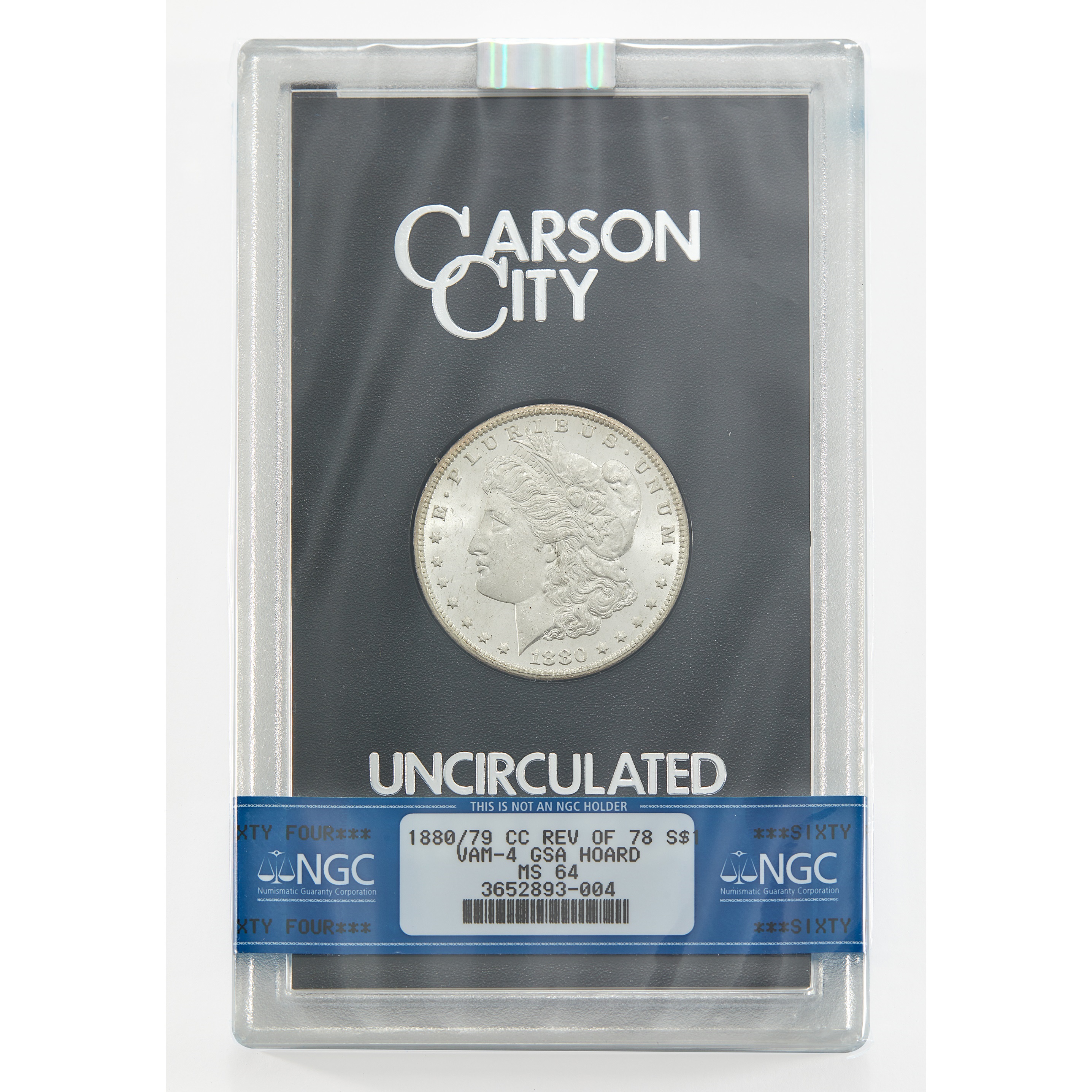
In the mid-1960s, the Treasury discovered bags of uncirculated silver dollars struck at the Carson City Mint, which traded at a premium relative to other silver dollars, owing to smaller mintages and, in some tellings, the mystique of the Comstock Lode and the “Wild West.” The General Services Administration (GSA) sold these coins in a series of sales from 1972 to 1980, preserving them in hard plastic cases with black boxes referred to by collectors as “hard packs.” In 2003, Numismatic Guaranty Company started grading and certifying Carson City Morgan Dollars, including many of the pieces available in the April 17 sale, affixing a band around the clear plastic holder bearing the grade and other relevant information. An 1880/79-CC Reverse of 1878 Morgan Dollar in a GSA Hard Pack well illustrates the layers of complexity in Morgan Dollar collecting: an example graded MS-64 by NGC appears in the April 17 sale (lot 6).
OTHER NOTABLE OFFERINGS
Further highlights of the April 17 auction include:
• Several rare early American medals
• A collection of early U.S. gold commemorative coins
• An intriguing themed collection of seventeenth, eighteenth, and nineteenth century medals depicting the globe, issued in numerous countries.
• An extensive collection of stamps and covers Trans-Mississippi Exposition of 1898
• Two Postal Money Orders issued in Hawaii in 1900, the last issued under the authority of the Hawaiian Republic and the first issued after Hawaii officially became a U.S. territory.
Auction Friday, April 17, 2026 at 10am
Exhibition April 11 - 13

Chris Bulfinch
Appraiser and Specialist of Coins, Stamps, Currency and Collectibles