05/03/2026 General, Old Master Paintings
NEW YORK, NY -- Featured in Doyle’s sale of Old Master Paintings on May 13, are two scenes from the life of the ancient Greek hero Achilles. These two are something of a rarity, as Achilles is not a subject that we see often in old master painting. In the 17th century the one major commission with this charismatic figure as its subject was a group of eight tapestries for which Rubens created designs at his workshop in Antwerp around 1630. But tapestries are enormously expensive to produce and thus not often imitated.
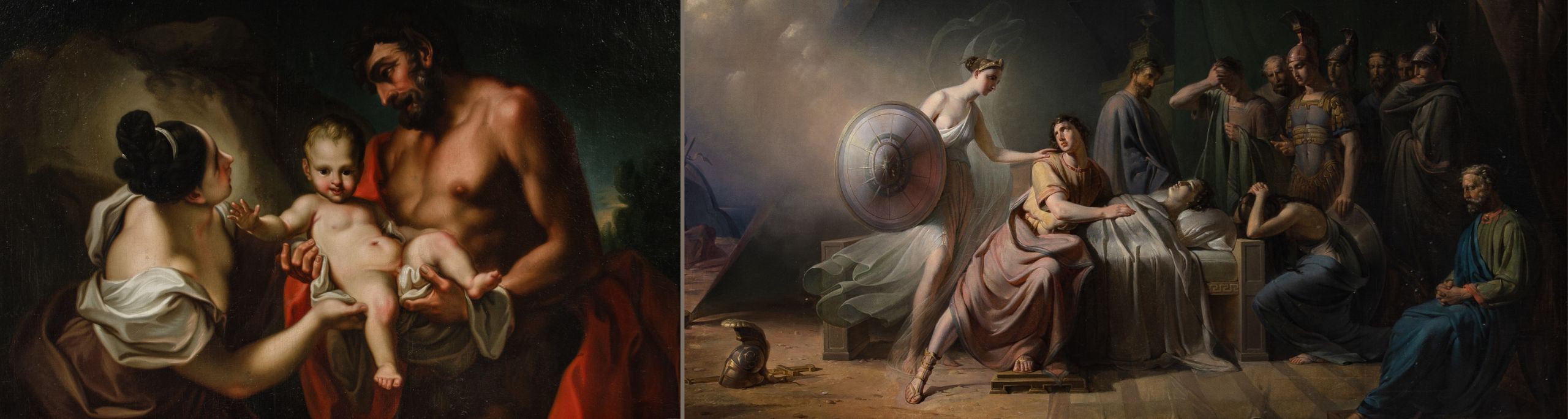
Nearly a century later, around 1715, the Italian artist Antonio Balestra (1666-1740) depicted one of the most heartwarming incidents in Achilles’s life: The Centaur Chiron Receiving the Infant Achilles [lot 15]. This is the beginning of the future hero’s early childhood education in the centaur’s care. As a boy he was consigned to this wise creature to be taught the accomplishments befitting a well-born man: the martial arts of archery, swordsmanship, and the use of a spear, and also music—particularly playing the lyre—philosophy, medicine, and an aristocratic code of honor.
In Balestra’s depiction of this subject we see a nymph—one of the companions of the sea goddess Thetis, Achilles’s mother—handing the infant to a smiling Chiron. The baby is smiling too—a veritable bundle of joy. Everything about this painting suggests a jubilant moment launching a young child on the way to a splendid future. We don’t know who commissioned this work, but it seems almost certain that it was painted in celebration of the birth of a nobleman’s firstborn son. There are at least two variants of this composition. One, considered the primary version, later became the property of King George III of England, and now belongs to Great Britain’s Royal Collection. A second version will be offered at Doyle on May 13.
The May 13 sale will also offer a portrayal of another pivotal moment from the life of Achilles. This is a monumental painting, created in 1847 by the Swedish neoclassical artist Johan Julius Ringdahl (1813-1882) [lot 54], Achilles Mourning the Death of Patroclus. Here we see Achilles in his tent, seated in deep grief beside the lifeless body of his dearest friend, Patroclus–who had been with him as a fellow student of Chiron in their childhood. As readers of the Iliad know, Patroclus had borrowed the armor of Achilles to go into battle with the Trojans. On that fatal day he met the Trojan prince Hector on the field and was killed. Hector had then stripped the armor of Achilles from Patroclus’s body as booty. Having heard Achilles’s screams of rage and anguish from the depths of the sea, his mother Thetis has now come to console him, bringing a new set of armor forged by the god Hephaestus himself. She urges him to take this new armament and go back into combat to avenge his friend and win glory. She knows that this will ultimately lead to Achilles’s death, but she also knows that this is what he needs to do.
Ringdahl has evoked this subject in a composition of grays, blues, lavenders, and browns. Into this somber atmosphere Thetis has come, touching Achilles’s shoulder tenderly. He turns toward her, understanding what she is trying to tell him. They both know that what he needs is heroic action and the fulfillment of his destiny. The other mourners stand silently by, knowing that they are bystanders at this tragic moment.
These two paintings together summarize the life of this archetypal hero. They are also both remarkable works of art, each in its different way.
Auction Wednesday, May 13, 2026 at 10am
Exhibition May 9 – 11
Below (l-r): Antonio Balestra (Italian, 1666-1740), The Centaur Chiron Receiving the Infant Achilles. Lot 15. (View) / Johan Julius Ringdahl (Swedish, 1813-1882) Achilles Mourning the Death of Patroclus. Lot 54. (View)